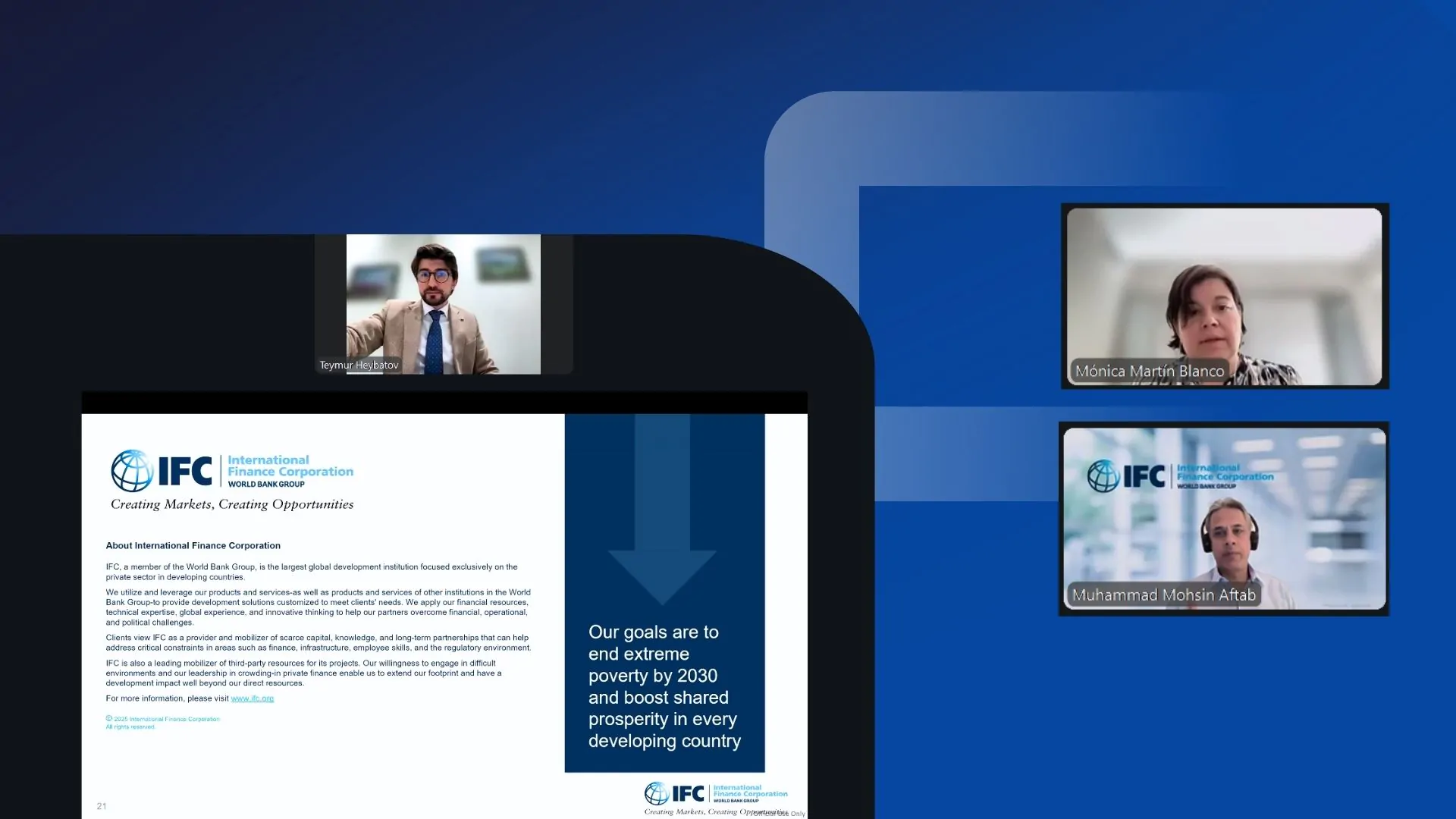

How can businesses unlock working capital without taking on additional debt burden? This question was discussed during an IFC (World Bank Group) webinar titled “Financial Instruments to Support Supply Chains: Opportunities for Business.”
Experts presented SUP participants with modern solutions that help companies improve liquidity, optimize supplier relations, and strengthen financial resilience.
The event was held as part of the cooperation between the Union of Ukrainian Entrepreneurs and IFC (World Bank Group), aimed at expanding Ukrainian businesses’ access to modern financial instruments and international best practices.
The speakers included Teymur Geybatov, IFC Project Lead in Europe on asset-based finance and an expert in financial services development, credit infrastructure, and financial inclusion; Mohsin Aftab, an international expert in supply chain finance and trade finance; and Monica Martín Blanco, an international legal expert in supply chain finance regulation and financial mechanisms.
What Supply Chain Finance Is
Experts emphasized that supply chain finance is not just a set of financial products or an alternative to lending. It is primarily a working capital management tool that enables companies to free up funds, accelerate cash flows, and strengthen relationships across the entire supply chain.
According to Mohsin Aftab, modern SCF solutions cover various stages of business processes — from procurement and supplier management to receivables financing and support for distribution networks.
One of the most widely used instruments is reverse factoring, which allows suppliers to receive faster payments for delivered goods while enabling buyers to optimize their own liquidity management.
Standardization and a Common Language for Business and Banks
One of IFC’s objectives is to create a unified approach to the use of supply chain finance instruments in Ukraine.
Experts presented a supply chain finance policy that includes standardized product definitions, implementation approaches, and performance assessment methods. This harmonization will enable companies and financial institutions to operate within a common terminology framework and simplify access to financial solutions.
According to IFC representatives, the document has already been shared with industry associations and the banking sector and is intended to serve as a practical tool for Ukrainian companies.
Legal and Accounting Aspects
Experts also addressed the legal and accounting dimensions of supply chain finance.
Monica Martín Blanco noted that such instruments are not traditional credit products. In many cases, they involve the sale or transfer of receivables rather than debt financing.
This is why the concept of true sale is crucial, as it ensures the full transfer of rights and risks associated with receivables. This affects accounting treatment, balance sheet structure, and helps avoid additional debt burden.
Experts stressed that successful implementation of such programs requires clear internal policies, procedures, and risk assessment criteria.
ESG as a Competitive Advantage
Participants also discussed the link between supply chain finance and ESG principles.
Experts noted that in developed markets, financing programs increasingly take into account environmental, social, and governance performance of suppliers. Companies can receive more favorable financing conditions by meeting defined ESG criteria.
According to IFC, Ukrainian businesses can use this approach as an additional competitive advantage, particularly in the context of European integration and evolving international partner requirements.
Practical Business Outcomes
During the webinar, experts presented examples of international companies that significantly improved their financial performance through supply chain finance tools.
In particular, case studies showed companies reducing their cash conversion cycles by dozens of days and freeing up tens or even hundreds of millions of euros in working capital without additional borrowing.
Speakers emphasized that the key advantage of such programs is the creation of value for all participants: buyers gain improved liquidity management, suppliers receive faster access to cash, and financial institutions obtain high-quality assets for financing.
Opportunities for Ukrainian Companies
In conclusion, IFC representatives stressed that the development of supply chain finance could become an important factor in strengthening Ukraine’s economic resilience and supporting small and medium-sized enterprises.
This is especially relevant in the context of economic recovery, when businesses need access to working capital and stable domestic supply chains.
IFC experts confirmed their readiness to provide methodological support to companies, assist in evaluating potential benefits, and facilitate the implementation of relevant policies and financial instruments in cooperation with financial institutions.
The Union of Ukrainian Entrepreneurs thanks the IFC team and project experts for the insightful discussion, practical recommendations, and support in strengthening the financial resilience of Ukrainian companies.