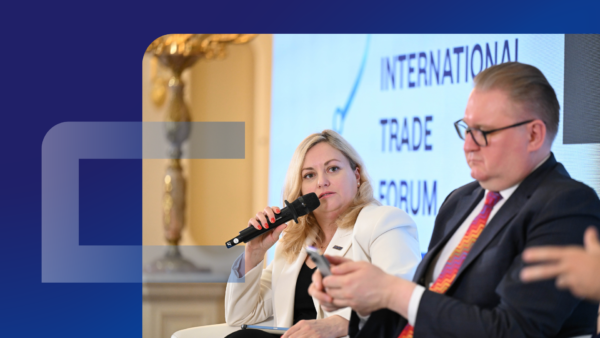
On 20 March, as part of “Better Regulation” actions, Union of Ukrainian Entrepreneurs gathered business and government representatives for discussing the necessity of developing a better regulatory framework for innovations market.
The round-table meeting was attended by Kseniia Liapina, Head of the State Regulatory Service, members of parliament Oleksii Mushak and Tetiana Ostrikova, and Ruslan Kuznetsov, Head of Post Service Expert Group of the Ministry of Infrastructure of Ukraine. Business was represented by Heorhii Sokolianskyi (Uber), Ramunas Macius (JTI), Inna Khomych (Nova Poshta) and Serhii Boichun (JayaDigital). Andrii Dlihach, CEO of Advanter Group, acted as moderator of the discussion.
Does the sphere presented by government as the driver of Ukrainian economy need legislative regulation? Representatives of Ukrainian business united around the necessity of introducing common standards for innovative products and clear market rules when it comes to consumer safety. However, most business players advocate “everything which is not forbidden by law is allowed” principle, which they claim will protect the market from overregulation.
During the discussion, Heorhii Sokolianskyi, Uber Development Director in Central and Eastern Europe, expressed his position on financial support for innovations. He noted that this tool is necessary only for the implementing social goals and must not disrupt market competition.
“Subsidies can be an effective mechanism for achieving social goals. Electric cars are an excellent example of a working subsidy in Ukraine. The ever-growing popularity of electric cars under favourable import regime enabled Uber to launch Uber Green fully electric service”, he added.
In turn, Kseniia Liapina, Head of the State Regulatory Service, emphasised that the legislative regulation often restrains market development.
“We must join forces for protecting “everything which is not forbidden is allowed” principle. Ukrainian business can easily operate without state regulation. Moreover, sectors with minimum or no regulation at all show positive development dynamics. The less regulation, the better the business develops”, she noted, having added that even the EU countries were suffering from overregulation.
In his turn, Ramunas Macius, JTI representative, noted that innovative products must be regulated in order to ensure the consumers’ rights.
“We believe that regulation in innovative spheres is necessary, particularly in e-cigarettes production. Here we have no control at all, in contrast to the overregulated traditional cigarettes market,” Macius said.
He noted that only 50 out of 180 countries, where the company sells its innovative products, regulate e-cigarettes production.
According to him, the regulation is necessary for several reasons. Firstly, consumer needs a high-quality and safe product. Secondly, tobacco and nicotine products must not be available to minors.
“New tobacco products are freely sold on the Internet and are publicly available. In addition, there are new manufacturers and brands emerging almost every month, so the market requires common quality standards,” the speaker noted.
In response, Head of the State Regulatory Service said that new tobacco products should not be overregulated in order to ensure equal competition on the market.
The issue of regulating innovation-related work in postal market was overviewed by Inna Khomych, Head of Legal at Nova Poshta.
She is positive: “A company that has created a new product or significantly modified the existing way of consumption should reasonably expect the state support in the implementation of its innovation. As there is the freedom of entrepreneurship guaranteed by the Constitution, and the principle of civil law regulation: “everything which is not forbidden by law is allowed.”
Inna Khomych, Head of Legal at Nova Poshta, added that postal industry is still regulated under outdated standards, which had been written back in the days of the USSR. For instance, current Postal Rules approved by the Cabinet of Ministers require that information about an addressee be written manually directly on a posting. At the same time, modern technologies make it possible to putting bar code on a posting containing all the necessary information, while complying with new personal data protection standards.
In turn, Ruslan Kuznetsov, representing the Ministry of Infrastructure, said that a new draft law “On Postal Services” was expected to solve personal data protection issue. He added that state regulation were to be implemented when the old standards restrain business development.
During the discussion, participants also raised the issue of regulating distance medicine selling. Today, the law prohibits to sell medicine via the Internet and to deliver it by mail. However, in practice, most pharmacies offer medicine delivery.
“We must protect consumers’ rights because they are at risk of consuming low-quality and expired medicine. We suggest lifting the ban on the delivery of over-the-counter medicine and set common rules for the delivery market in this sphere,” Khomych said.
This position was supported by Tetiana Ostrikova, Head of the Sub-Committee on Customs Affairs and Customs Code Improvement of the Verkhovna Rada of Ukraine, and Kseniia Liapina, Head of the State Regulatory Service. By the way, Union of Ukrainian Entrepreneurs has already initiated formation of a working group within the SRS for the regulation of distance medicine selling.
Finally, participants in the round-table meeting discussed regulation of the digital assets market in Ukraine.
“We must start with basics: firstly, define what we are going to regulate, i.e. define a digital asset. Secondly, we want digital contracts to work on the Ukrainian market, which requires adoption of legislation that will enable the use and circulation of digital tokens in the form of ordinary securities,” Serhii Boichun, JayaDigital representative, said.
MP Oleksii Mushak told that Ukraine was among world’s TOP-10 markets by cryptocurrency transactions.
“There are two approaches to regulation of this market. The first option is to define regulator, procedures, etc., which can stop development of the market. There is another approach: we define and say what must be paid to budget,” Mushak pointed out.
In the context of discussion, Tetiana Ostrikova noted the existence of tax issues in state’s aspirations to “over-regulate” innovation. Products that are just emerging on the market and have not yet been defined in legislation, as a rule, are already defined in the Tax Code of Ukraine.
“First of all, members of parliament want to charge taxes on all the innovations. It is the Tax Code where the distortion of competition starts in the first place,” Ostrikova said.
The issue of regulating innovations is a pressing issue for business, hence the discussion was fruitful. We thank the business for presented initiatives for improving the innovations market environment, and the authorities for their attention to each position, since this sphere can become one of the drivers of Ukraine’s economic growth.